Annual fee and energy costs
Hjorthagshus has among the highest annual fees in Sweden. The reason for the high annual fee is mainly the sky-high energy losses.
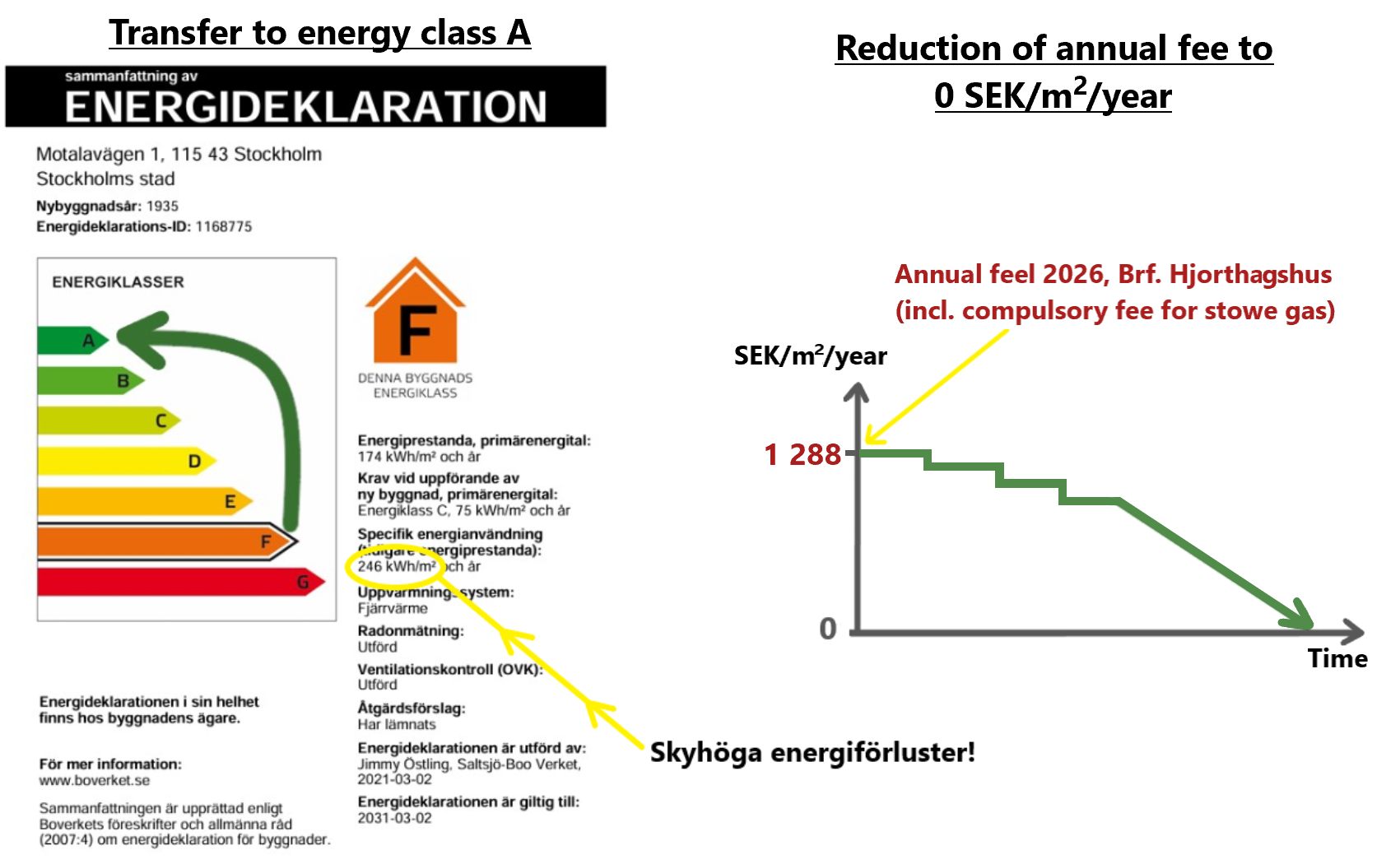
If the association undertakes thorough energy efficiency measures, the annual fees can first be frozen, then gradually reduced to zero.
.
Increased annual fee on 1 January 2025 and 1 January 2026
The increases in the annual fee of 10 per cent introduced on 1 January 2025 and 3 per cent on 1 January 2026 were not needed. The association’s energy losses can easily be reduced by amounts corresponding to the income generated by the increases. When energy losses are eliminated, permanent measures are taken that lock the energy use at a lower level. Dealing with increased energy costs by repeatedly raising the annual fee leads to the wrong thing: unreasonable housing costs and depressed value of the tenant-owned apartments. Financial instability is created!
.
The association’s total energy costs
Below are the estimated total energy costs for members in 2024.
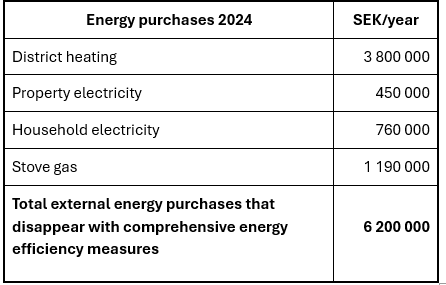
The above costs disappear completely with comprehensive energy efficiency. Hjorthagshus buildings have an advantageous location directly on the bedrock and large roofs in a free position, which together allow for energy autonomy. Energy costs are interesting because they can be internalized (“brought home”) to the association and become an income that enables reduced annual fees.
When energy purchases have ceased after comprehensive energy efficiency improvements, energy costs are not present at the same time as various maintenance costs are reduced. It is mainly the recurring window renovation that disappears when maintenance-free low-energy windows are installed. Roof replacement costs are also eliminated as the roof is converted into a comprehensive, waterproof solar energy system.
.
Inflation, annual fees and profits from energy efficiency
Inflation has a very significant impact on future energy costs. Every year, energy costs are increased by inflation that is added to previous years’ inflation (interest-on-interest effect). In the long term, the accumulated costs will have a major impact on the annual fees. Below are the cost developments at different inflation rates. Investments in energy efficiency are made in nominal amounts and disconnect the association from the future energy price spiral with inflation-on-inflation.
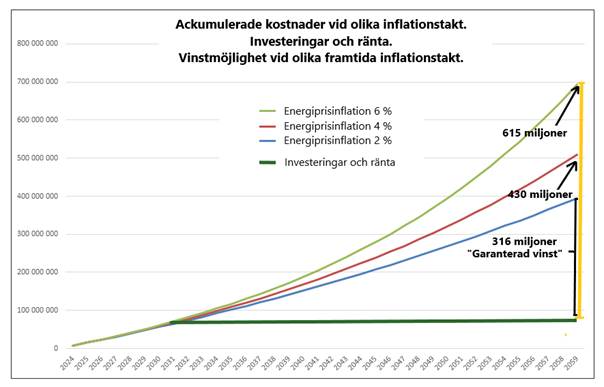
The horizontal green line in the chart above is the association’s investments. The curved upward curves are the association’s return (reduced energy purchases) on the investments. The difference is the association’s profit, which enables large reductions in the annual fees.
The size of the profit depends on the future rate of inflation. The inflation rate of 2 per cent (blue line) is the inflation rate that we know will exist because the Riksbank promises it. As for energy prices, they have risen well above the general inflation rate of 2% over the past decade. Over the past 10 years, electricity prices have risen by an average of 7 percent per year. District heating has increased by an average of 9 percent over the past three years.
The Energy Markets Inspectorate has given the go-ahead for sharp future increases in electricity prices. Remote companies want to increase by the same amount. An uncertainty factor for price development is that more property owners are shutting off district heating, which means that the district heating company has to spread its fixed costs over fewer customers. In the district of Hammarby Sjöstad, half of the housing associations have turned off district heating and are instead using heating coils. In all of Sweden, clearly more than half of all buildings are heated with heat pumps.
The chart above shows that even at the guaranteed inflation rate of 2 percent, the yield is about SEK 316 million, or an average of SEK 9 million/year. If the average energy price inflation instead becomes a fully possible 6 percent, a profit of about SEK 615 million is created, which corresponds to an annual average profit of about SEK 17 million/year.
.
.
Wealth increase for members
Energy autonomy for associations will lead to increased values of members’ tenant-owned apartments. The higher valuation arises thanks to:
- Low annual fees
- Immunity to future energy price increases
- Increased living comfort
- Minimal climate impact “feels good” and provides green mortgages
A reasonable assessment is that the apartment value will rise by 15 percent when all measures are implemented. In associations that have carried out thorough energy efficiency improvements, there is an increase in value at this level when compared with equivalent tenant-owned apartments in the same area. Given that the association shares with new apartment speculators the plan for energy autonomy, minimal climate impact and low annual fees, a certain increase in value can take place already when the measures begin. An increase in value of 15 percent means that today’s value of around SEK 75,000/m2 rises to SEK 94,000/m2.
A 40 m2 apartment increases in value by SEK 450,000… without the member actually doing anything.


.
Let the annual fee be zero?
There are tenant-owner associations with zero annual fees. Good financial management with real and financial savings has resulted in the positive situation.

Hjorthagshus can use the gains from comprehensive energy efficiency improvements for financial and real savings with returns. Commercial banks offer discretionary management, which means that the bank manages its assets and uses historical statistics for various investment opportunities. For example, the association can order an 8 percent annual return on its savings.
.
Legal angles
A tenant-owner association is legally an economic association. Therefore, in Brf. Hjorthagshus’ statutes, § 1 there is the rule: “The purpose of the association is to promote the economic interests of its members…”. The wording is taken verbatim from the Act (2018:672) on Economic Associations, § 4: ” …/… has the purpose of promoting the economic interests of its members …/….
In the legislative history of the Act, it is stated that membership in a tenant-owner association must be (financially) advantageous. Unfortunately, it is financially disadvantageous to be a member of Hjorthagshus due to recurring increases in annual fees when energy prices rise.
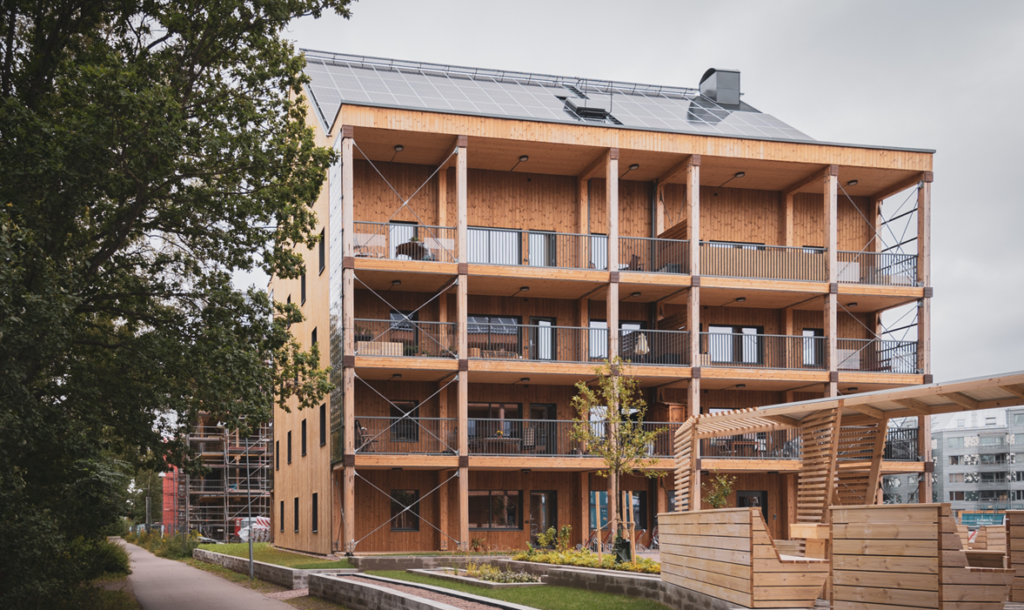
Apartment building on Rangatan in Västerås that maintains an indoor temperature of 21 oC without district heating. The building delivers more electricity than it uses. Designed by architect Hans Eek, who is pleased to show the building to visitors.